
What would changing Britain's voting system actually do?
The prime minister has promised a commission on replacing first past the post. Votes and seats were further apart in 2024 than at any election on record, but forecasts of what a new system would bring rest on guesses about how people would vote.
How far apart are votes and seats under first past the post, and how far can we trust forecasts of what proportional representation would change?
Part 1
What this is about
MPs are elected under a system called first past the post. The country is split into 650 areas, called constituencies. In each one, the candidate with the most votes wins, even if most people voted for someone else. Votes for the losing candidates elect nobody.
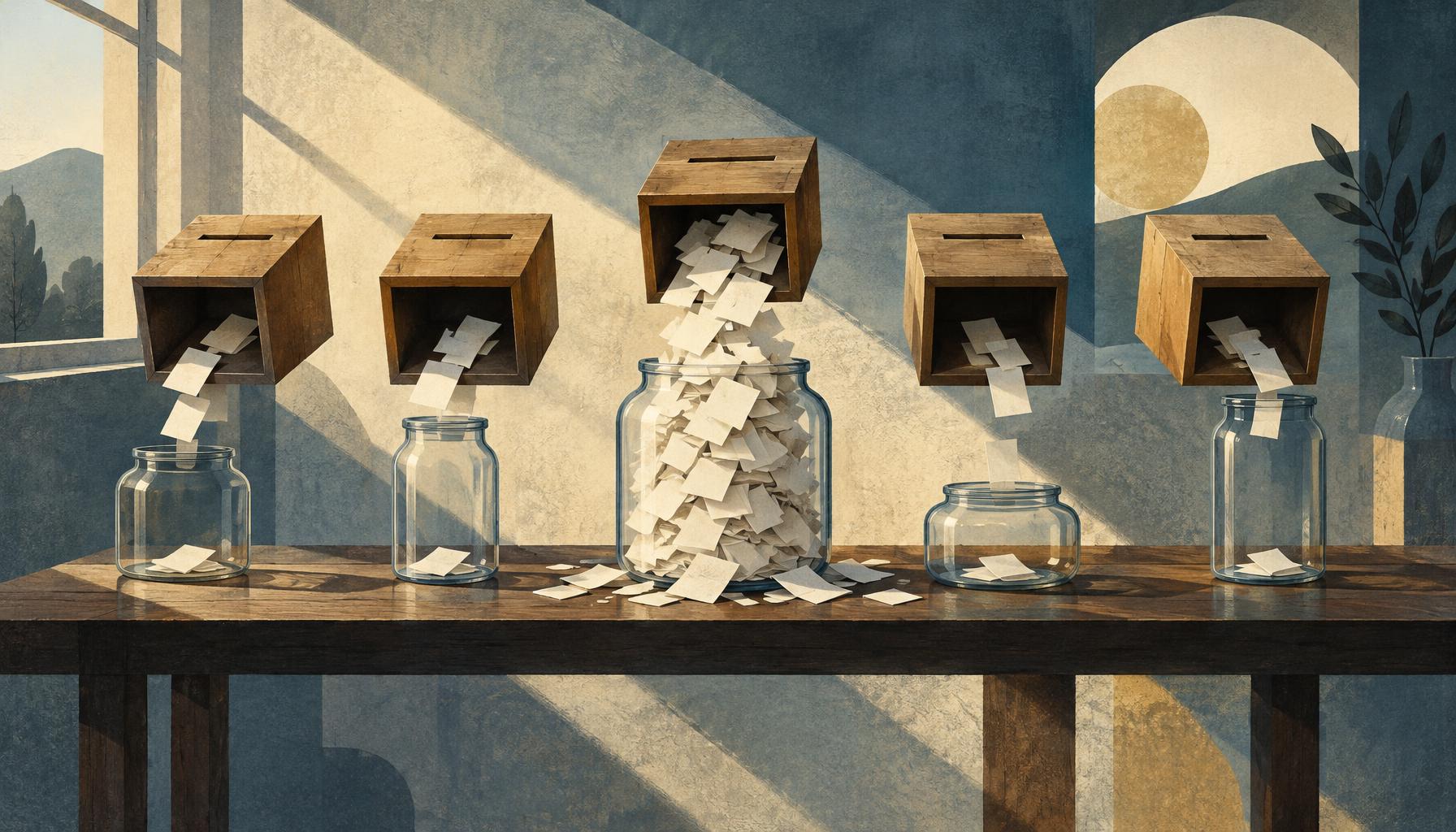
This tends to reward parties whose support is bunched in the right places and to punish parties whose support is spread thinly. In 2024 Labour won 33.7% of the UK vote and 411 seats, or 63.2% of all MPs. Reform UK won 14.3% of the vote and 5 seats. The House of Commons Library says the gap between votes and seats was the largest on record. No party has won half the vote at a general election since 1945. The highest share since then was 49.7%, for the Conservatives in 1955.
The main alternative is proportional representation (PR). This is a family of systems that share out seats roughly in line with votes. Parts of the UK already use them. The Scottish Parliament mixes local and regional seats. Northern Ireland's Assembly and Scottish councils let voters rank candidates in larger areas that elect several members. The Welsh Senedd switched to party lists in May 2026.
Voters have been asked about change before. In 2011 a referendum offered the alternative vote, where people rank candidates in their own constituency. It is not a proportional system. It was rejected by 67.9% to 32.1%, on a turnout of 42.0%.
The issue is back because Andy Burnham, prime minister since July, told Labour's conference on 29 September that he would set up a national commission on electoral reform. He said Labour would fight the next election promising to change the voting system. Labour says the commission will report before that election, but it has no chair or start date yet. This week Lord Blunkett, a former Labour home secretary, urged caution in the i Paper, and some Labour MPs have said they prefer the current system.
63.2%
of MPs won by Labour in 2024
On 33.7% of the UK vote. House of Commons Library.
823,522
votes for each Reform UK MP in 2024
Against 23,622 for each Labour MP. Electoral Reform Society, from official results.
67.9%
voted No to changing the system in 2011
In the referendum on the alternative vote, on a turnout of 42.0%. House of Commons Library.
Explainers
The same story in the format that suits you: watch it, listen to it, or take it in at a glance.
AI-generated overviews (NotebookLM) · Made automatically by Google NotebookLM from this page. If a figure differs, the figures on this page are the checked ones.
Part 2
What's being said
“Labour won 63% of MPs on just 34% of the vote in 2024”
Darren Hughes, chief executive, Electoral Reform Society · 29 September 2026
Campaign groupHow it was used
In the society's response to Burnham's conference announcement. The same sentence goes on to say the large majority did not bring stability.
How it could mislead
The figures are right. On their own they cannot show what a fairer result would have been, because people might have voted differently under another system.
What the figures say
Commons Library figures confirm it: 411 of 650 seats (63.2%) on 33.7% of the UK vote. That was a lower vote share than any party forming a post-war majority government.
“a divisive government on less than 30% of the vote”
Andy Burnham, Prime Minister and Labour leader · 29 September 2026
LabourHow it was used
Said in his Labour conference speech while announcing the commission, as a warning of what could happen if the current system stays.
How it could mislead
It describes a possible future government, not a past one. The warning would apply to any party. More in Common's September model has Labour largest, on 26% of the vote.
What the figures say
No party has formed a majority government on less than 33.7% since 1945. More in Common's September model gives Labour 250 seats on 26%, but the group says it is not a projection.
“the purest form of proportional representation in the world”
Lord Blunkett, Labour peer and former home secretary
LabourSource neededHow it was used
Describing Israel's election on 27 October, in comments reported by the i Paper as a warning to Burnham that PR can give small parties power.
How it could mislead
Israel elects its whole parliament from one national list. That is one end of the PR family. The commission has not chosen a system, and some keep local representatives.
What the figures say
Israel elects all 120 members from a single nationwide list, with a 3.25% threshold. The PR systems already used in the UK, in Scotland and Northern Ireland, keep local areas.
Part 3
What the figures show
How far apart were votes and seats in 2024?
Labour took 33.7% of the UK vote and 63.2% of the seats. The Conservatives won 23.7% of the vote and 121 seats. The Liberal Democrats won 12.2% and 72 seats, because their votes were concentrated in places they could win. Reform UK won 14.3% and 5 seats. The Green parties won 6.7% and 4 seats.
The Electoral Reform Society, which campaigns for PR, scores 2024 at 23.6 on a common measure of the gap between votes and seats (the Gallagher index). The previous high was 20.6 in 1983. Turnout was 59.7%, down from 67.3% in 2019.
UK general election. Reform seat share is our calc (5 of 650).
What would a new system change?
More in Common, a research group, asked voters in July how they would vote under each system. Under first past the post its model gave Reform UK 46% of the seats on 28% of the vote. Under regional party lists Reform got 28% of the seats. The Greens' seats rose by 770 per cent, and the SNP lost more than half of its seats.
The group says it cannot predict how parties would campaign, or which might split, merge or form under a new system. Its September model, built on different polling, put Labour largest with 250 seats on 26% of the vote. It says that model should not be seen as a projection of the election.
What the UK already uses
Several UK elections are already proportional. The Scottish Parliament and London Assembly use the additional member system. Northern Ireland's Assembly and councils in Scotland and Northern Ireland use the single transferable vote. The Senedd moved in May 2026 to closed party lists, with 96 members from 16 areas that elect six each.
Neither election in May 2026 produced a majority. In Wales, Plaid Cymru won 43 of 96 seats and Reform UK 34. In Scotland the SNP won 58 of 129 seats, short of the 65 needed. Labour MP Henry Tufnell told PoliticsHome that in Wales he saw how accountability can be lost under PR. Supporters of PR say it makes parties work together.
What the parties say
Labour's commission will invite all parties and the public and report before the next election. It has not said which system it prefers, and Labour's 2024 manifesto made no promise on the voting system. The Liberal Democrats want the single transferable vote, and Ed Davey told Burnham in July that "my door is open". The Greens, SNP and Plaid Cymru backed proportional systems in 2024. The Greens' Ellie Chowns welcomed the commission but objected that change would wait for another election under current rules.
The Conservatives' 2024 manifesto said they "remain committed to the First Past the Post system". Reform UK's 2024 manifesto called for a referendum on PR. In May 2025 its chairman, Zia Yusuf, told the Spectator the party was "firmly in favour of first past the post". We found no response from either party to the commission.
The other side
- The gap is real without any forecast The 2024 figures need no guesswork. The Commons Library says the gap between votes and seats was the largest on record. In February dozens of academics wrote to the government warning the system could produce "random and arbitrary" results.
- Local links and clear winners Supporters of first past the post value the link between one MP and one area. Labour MP Jonathan Brash told the i he would never back a system that weakened it. By our count, 19 of the 22 general elections since 1945 gave one party a majority.
- Some forecasts ask voters directly More in Common's July model asked people how they would vote under each system, rather than simply rerunning first past the post votes. That is closer to a fair test, though the group says it still cannot predict how parties would change.