
What does approving Jackdaw mean for jobs, emissions and energy supply?
The government has approved the Jackdaw gas field. It adds a small share of Britain's gas and a few hundred jobs, and both sides quote whole-field totals that are bigger than what the decision changes.
What difference does approving the Jackdaw gas field make to Britain's energy security, jobs and greenhouse gas emissions?
Part 1
What this is about
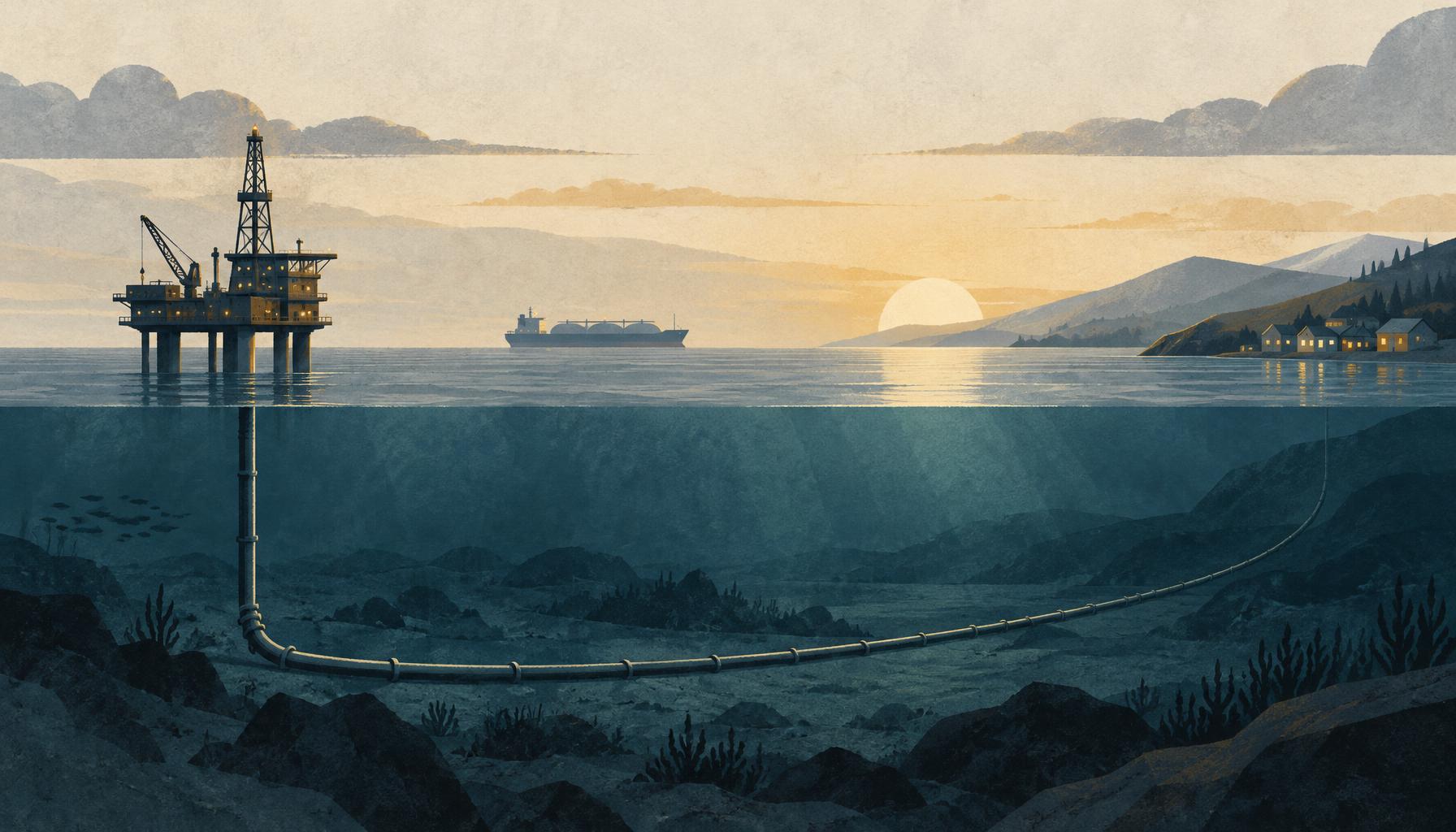
Jackdaw is a gas field under the North Sea, about 250 kilometres east of Aberdeen. It belongs to Adura, a company owned jointly by Shell and Equinor. Its platform is already built. On 21 October the energy secretary, Miatta Fahnbulleh, agreed that the regulator could let it start producing. The first gas is expected as early as the end of October, and the field should run until about 2037.
This was the second time Jackdaw was approved. The last Conservative government gave consent in June 2022. In January 2025 a Scottish court ruled that consent unlawful, because nobody had assessed the pollution from burning the gas once it is sold (known as scope 3 emissions). The government issued new rules on how to assess those emissions in June 2025, and Adura applied again.
The decision matters because Britain's own gas is running down. The UK produced 332 terawatt-hours of gas in 2025, its lowest output since the 1970s, and used 680. A terawatt-hour is a unit for very large amounts of energy. About half the gas Britain used came from abroad, mostly by pipeline from Norway. Three in ten imported units arrived by tanker as liquefied gas, about three-quarters of it from the US.
The argument over Jackdaw sits on three questions. Does it make Britain's energy supply more secure? How many jobs does it bring? And what does it do to the climate? Supporters stress the first two and opponents the third. Ministers have said that it will not cut household bills, because gas prices are set across Europe.
The decision also carries politics. Labour promised no new exploration licences, but Jackdaw already had one. The chancellor announced an Energy Wealth Fund alongside it, starting with £2 billion, to be topped up from North Sea taxes. A decision on Rosebank, a larger oilfield west of Shetland, is still to come.
About 3%
of the gas Britain uses that Jackdaw could supply at its peak
our calc from Adura and DESNZ; about 6% of UK production
27
new direct jobs, with 273 existing jobs safeguarded
developer figures, published by the government
30.5 million tonnes
of carbon dioxide from burning Jackdaw's gas over its life, high case
government decision document
Explainers
The same story in the format that suits you: watch it, listen to it, or take it in at a glance.
AI-generated overviews (NotebookLM) · Made automatically by Google NotebookLM from this page. If a figure differs, the figures on this page are the checked ones.
Part 2
What's being said
“will protect hundreds of jobs and help keep millions of homes warm this winter”
Andy Burnham, Prime Minister · 21 October 2026
GovernmentHow it was used
In the government's press release announcing the approval, alongside the new Energy Wealth Fund.
How it could mislead
The jobs figure is the developer's own. The homes figure is an equivalent at full output, and the field will only be starting up this winter.
What the figures say
The developer says 27 new jobs and 273 safeguarded, about 300 in all; BBC Verify reports about 500 including roles on nearby hubs. Adura says Jackdaw can heat the equivalent of 1.4 million homes, once it reaches full output.
“Jackdaw will not bring down bills and will create only 27 jobs”
Ellie Chowns, Green Party MP · 21 October 2026
GreenHow it was used
At Prime Minister's Questions on the day of the approval, citing the energy secretary's own statements to argue against the decision.
How it could mislead
The 27 counts only new direct jobs. It leaves out the 273 existing jobs the developer says the field keeps going, and roles on nearby hubs.
What the figures say
Both parts match official statements. The energy secretary said Jackdaw won't mean cheaper bills. The government lists 27 new direct jobs and 273 safeguarded. BBC Verify reports about 500 in total, including roles on nearby hubs.
“help minimise the UK’s use of imported higher emission fuels”
Miatta Fahnbulleh, Energy Secretary · 21 October 2026
GovernmentHow it was used
In the government's announcement, explaining why she agreed that the regulator could grant consent.
How it could mislead
Producing gas at home does pollute less than shipping it in. But most of the field's emissions come from burning the gas, which is the same wherever it comes from.
What the figures say
BBC Verify, citing the regulator, says emissions from producing and shipping US liquefied gas are about three times those of North Sea gas. Jackdaw's own production emissions are under 1 million tonnes; burning its gas gives about 30.5 million.
Part 3
What the figures show
Does it make supply more secure?
The government says Jackdaw will produce about 6% of the UK's own gas at its peak, and about 5% on average over its life. Britain produces only about half the gas it uses, so at the peak that is about 3% of the gas Britain uses (our calc). BBC Verify puts it at about 1.6% of the gas Britain is expected to use over 2026 to 2036, because output falls after the first years.
Supporters say home-grown gas cannot be sold to other countries in a crisis the way tanker cargoes can. Opponents say the field is too small to change Britain's dependence on imports. Both points can be true. Norway supplied 69% of Britain's gas imports in 2025.
Terawatt-hours. Jackdaw at its peak is our calc: about 6% of UK production
How many jobs?
The government's announcement gives the developer's figures: 27 new direct jobs and 273 existing jobs safeguarded. BBC Verify reports about 500 jobs once roles on nearby North Sea hubs are included, an estimate from the owner. The platform is unstaffed most of the time, and most of the building work is already done.
Larger figures describe the whole industry. Offshore Energies UK, the industry body, says the sector supports over 200,000 jobs. Unite's leader, Sharon Graham, welcomed the decision, saying workers cannot let go of one rope before holding another. The worry for unions is the wider decline of the North Sea, not Jackdaw on its own.
What does it do to the climate?
The government's decision document estimates that burning Jackdaw's gas would release about 30.5 million tonnes of carbon dioxide over the field's life, in its high case. Counting the energy used to produce and transport it, the figure is about 35.8 million. Running the platform adds about 0.8 million tonnes. The document gives these emissions moderate weight against the project, but concludes they will not stop the UK meeting its carbon budgets or net zero by 2050.
The difference the decision makes is smaller and disputed. If Jackdaw's gas replaces imports, the gas is burned anyway. Wood Mackenzie, a consultancy, estimates that replacing it with US liquefied gas would add about 3.5 million tonnes, from extra production and shipping. The Climate Change Committee has said gas burned in Britain counts against its carbon budgets wherever it comes from.
What the parties say
The government calls it a pragmatic approach to the North Sea, and says new North Sea tax will help fund clean power. It keeps its ban on new exploration licences. The Conservatives, who first approved Jackdaw, say Labour delayed it and want the ban lifted and Rosebank approved. Reform UK backs more drilling and says net zero policies push up costs.
The Green Party calls the decision climate vandalism and says it will not lower bills. The Liberal Democrats say the UK has been too slow to cut gas demand and want a national electrification plan. The SNP's First Minister, John Swinney, said it should bring some certainty for the north east.
The other side
- Small fields still add up Supporters say judging each field alone hides the bigger picture. Production is falling by around 12% a year on the regulator's forecasts, and a run of small fields could slow that fall.
- Totals are not the whole climate story Climate groups argue that counting only the difference from imports assumes demand never changes. They say approving new supply makes it harder to cut gas use.
- The jobs are mostly in the past Most of the construction work on Jackdaw has already happened, since the platform was built before approval. That is why the new-jobs figure is small, and why supporters point to jobs safeguarded rather than created.